What the Sun Allows Us to See When It Steps Aside
On eclipses, fallback, and the parts of us that only show up in the dark

Yesterday, several friends messaged me some version of the same thing: running off to don their protective eyewear, tilting their faces up toward Europe’s sky, waiting for the moon to eclipse the sun. It brought me back to a piece I wrote a few years ago after I stood in my own path of totality…the experience of which I’d let go soft and quiet since then.
You know how that happens. A truth lands hard, and then life sands the edges off it until you almost forget you knew it.
It feels like the right moment to sharpen it again. Not because there’s a tidy hook. (No eclipse-spying of my own this time.) But because darkness and shadow are so much with us right now, in the world and in ourselves, that it seems worth asking what they might be offering. What becomes visible, exactly, in the moments the sun isn’t stealing the show?
Here’s the piece I originally published on April 10, 2024…
What a total solar eclipse can reveal to us about the gifts of the darkness and the light of being human
The shadow moved in slowly, steadily, subsuming the brilliant, hot light in nearly imperceptible increments. I watched it in awe, an inverse image of how I know the universe to work. Full moon nibbled away bite-by-bite toward waning crescent. Only it wasn’t the moon that appeared as if it was being consumed. It was the sun. The all-powerful star of the daytime show at the peak of its performance, eclipsed by a smaller player — the moon.
I paused to take note of the beings that are far more sensitive than I to the movement of the earth, the solar system, the cadence of time and the interplay of molecules. They seemed to be pausing, too. Stillness. A moment to notice, to sense, to be in awe.
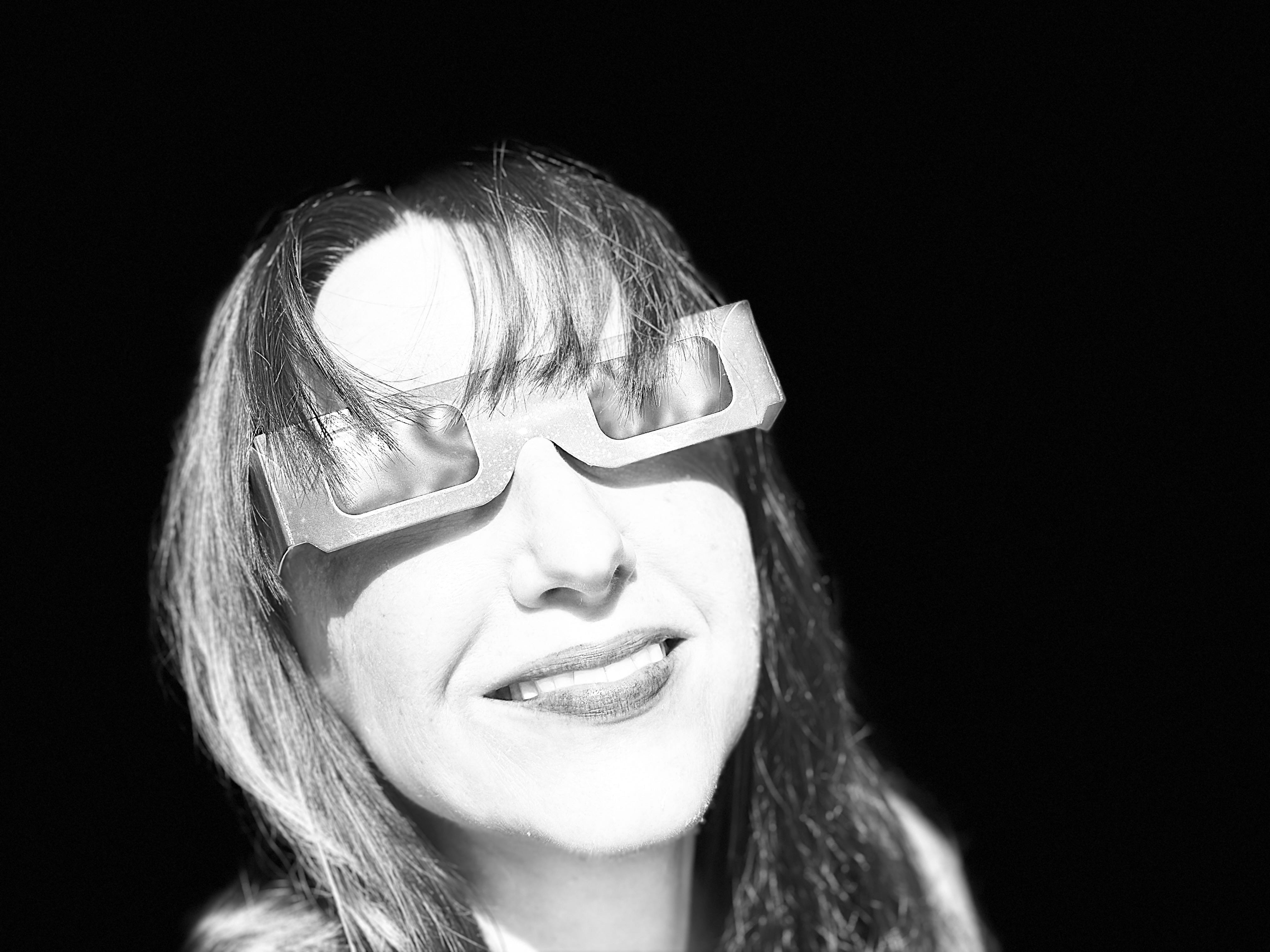
I grinned my way through the entire day, listening to reports from people who were fortunate to witness the totality — shadow eclipsing light, day turning to night — those who were able to sit in the darkness and appreciate its wonder, to see what it revealed that we are unable to observe when the sun is in its full glory, uninhibited by its lesser co-star. On this day, for a few moments, the star of the show relinquished the spotlight to the moon.
And when the moon and its shadow took center stage, we could see both the moon and the sun more clearly.
Bailey’s Beads revealed the rough topography of the moon’s surface, allowing the sun’s light to pierce through like jewels. And just before the eclipse reached totality, as Bailey’s Beads ducked behind the moon, one could see the “diamond ring” — one brilliant beacon of light fastened around the moon with the ring of the sun. We could see the surface of the moon in all of its imperfections. And because of these imperfections, because of the center-stage position of the moon, even though the full force of its brilliance was obscured, we were able to see the sun itself more clearly.
And we cheered, we wept, we celebrated — because we knew this was a moment (or four) that would pass. We knew the light would come again, and thanks to science, we knew when. We understood what was happening, an understanding that ancient civilizations didn’t have.
As Dan Falk explains in The Smithsonian Magazine, “Around the world, myths and legends grew up around the phenomenon. In ancient China, a solar eclipse signaled that the sun was being devoured by a dragon; people would bang drums and make loud noises to scare off the beast and bring back daylight. In South America, the Inca saw solar eclipses as a sign of the sun god’s displeasure; leaders would try to divine the source of his wrath and appease him with an appropriate sacrifice.”
And so often, this is our reaction, when the moon eclipses the sun in our solar system of self. This is how we often experience our fallback. In our constriction, we feel as if our more complex self is being devoured by a dragon. We bang our figurative drums and make loud noises to scare off the beast, so fearful are we that if it stays, the daylight of our bigger self may never return. Sometimes we succumb to our fallback, trying to appease it with the ritual sacrifices that are aplenty when we find our stage overtaken by the smaller versions of ourselves. We fear the darkness has come for good, forgetting that this, too, is a moment that will pass. We may weep, but we absolutely do not cheer and celebrate, and certainly not in the company of others.
But what if we did?
What if we were to cheer and celebrate the darkness of fallback and all that it paradoxically illuminates, as many of us did this week when the moon eclipsed the sun? What if in the approaching shadow of fallback, we paused to observe and to sense what the wisdom of our less mature self might reveal that we are at other times unable to see? What gems might we discover if we were to give attention to the rough terrain of an earlier way of knowing self and the world around us, a territory marked by our most cherished values and deepest fears?
What if we were to connect to the awe of what it is to be human — brimming with luminosity and shadow, with light and dark, that sometimes we can appreciate and understand only because some aspect of our shining star of self is obscured for a time? How might our acknowledgement of the intimate dance of our own darkness and light reveal the brilliance of both, together? How might our willingness to do this in the company of others also witnessing and experiencing the wonder of what it is to be human, in both its moves forward and its stumbles back, reveal to us even more? And because we understand the phenomenon of fallback and that this, too, shall pass, how might we begin to appreciate its preciousness, its glory?
On April 8, 2024, I glimpsed that this was possible, and I basked in the light and reveled in the shadow.
Now, more than two years later, I’m still practicing the stilling and the steeling with my own shadow…and with the ones I witness moving within the people I love. Yesterday’s eclipse was a reminder that we don’t get to choose when the sky goes dark. We only get to choose whether we run for our glasses or turn away.
Val

Spread the word…
If you’d like to see this community grow, we hope you share this article with others who could benefit from the reflection.
and, if you haven’t already, please Subscribe to support our work!
Want to experience or revisit the April 8, 2024 solar eclipse? My friend, Charles J. (Chuck) Palus, captured the eclipse with his telescope and iphone. I love the musical accompaniment! This one is going straight to The Soundtrack of My Development.
Dive deeper
Join our in-depth, self-led developmental course for adults who raise and educate children - Growing Humans: How Raising Children Raises Us.
Head over to the program page to learn more.